You made it here!
Which tells me you’re paying attention.
Good.
Because what you’re about to read is one of the most misunderstood words in family court,
and one of the easiest ways people unknowingly sign away leverage: stipulation.
Before we get into definitions and legal language, let me tell you why this matters.
If you’ve spent any time on this site, you already know I don’t take information at face value.
I dig,
I verify, and
I read transcripts line by line until the truth shows itself.
Long before this platform existed, I was part of a group of parents (mostly mothers) who had all been pulled into the CPS system at some point.
We shared stories, documents, frustrations… and patterns started to emerge.
That’s where I met Joyce Joplin.
Joyce lives in Illinois and has five children.
Her case started with allegations of “medical neglect.”
She followed the plan.
She completed the classes.
She checked every box the system told her to check which as we all know is the exact path parents are promised will lead to reunification.
But reunification never came.
Instead, her rights to her two youngest sons were terminated.
One child aged out of the system.
Her two daughters were placed with their fathers.
The outcome left her shattered and essentially questioning how everything went so wrong when she had done everything she was told to do.
Then one day she ordered a transcript from a recent hearing involving her daughter.
While reading through it, a phrase jumped off the page, a statement from the State’s Attorney, Dora Mann, referencing a “stipulation of adjudication.”
That single line changed everything.
Curiosity turned into investigation.
I started digging into what that phrase actually meant (not the watered-down explanation people hear in court), but the real legal effect behind it.
What I uncovered was enough to make me pick up the phone immediately.
“Listen,” I told her, “I think I just figured out how they’re doing this… and why it keeps working.”
She was confused.
She thought she had simply agreed to move the case forward...nothing more.
What she didn’t realize was the legal weight hidden inside that one word: stipulation.
And that’s where your education starts.
What a “Stipulation” Really Is — And Why It Matters More Than Most People Realize
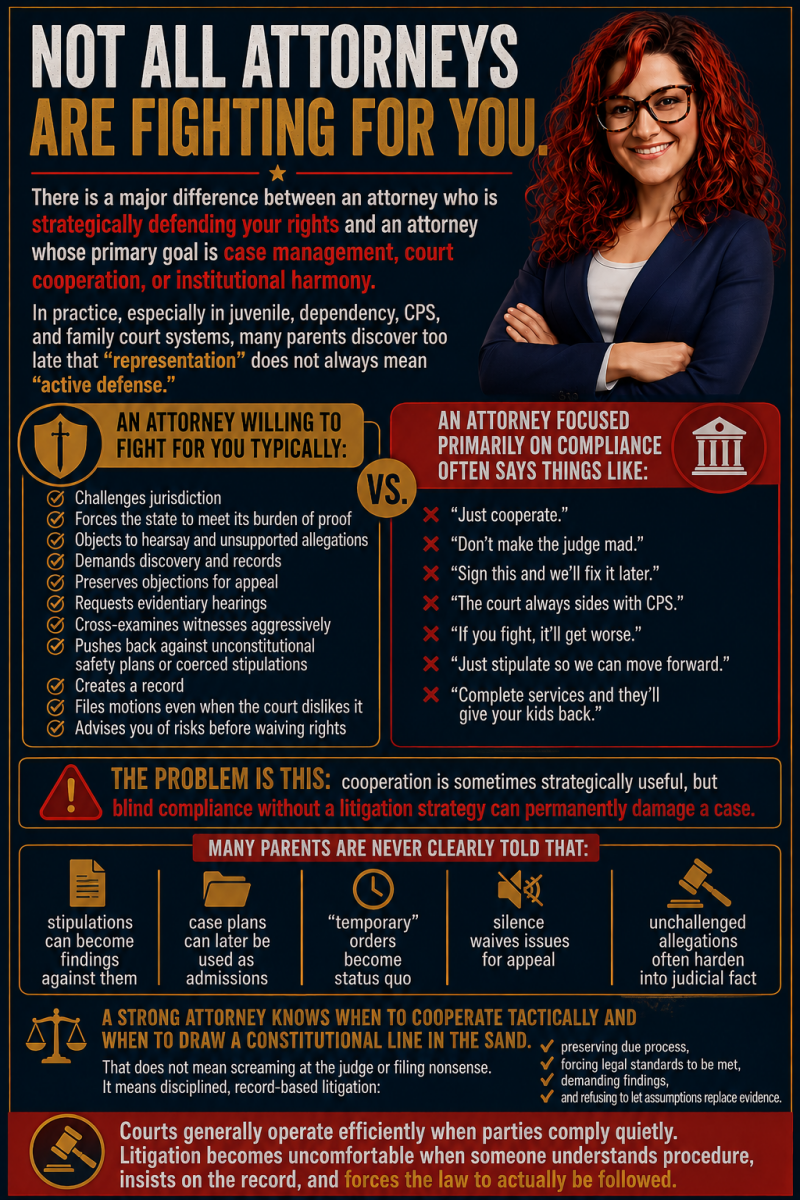
In plain legal terms, a stipulation is an agreement between CPS, your attorney (and supposed to be the parent) that certain facts, issues, or procedures will be accepted without requiring proof through testimony or evidence.
Courts rely on stipulations to save time.
Attorneys use them to streamline hearings. On paper, they sound harmless — even practical.
But in family court, especially in abuse, neglect, or dependency cases, a stipulation can carry consequences that many parents do not fully understand in the moment.
When you stipulate, you are essentially telling the court:
“I don't need CPS to prove this allegation through a full evidentiary process.”
“I agree that the court can rely on these facts — or at least proceed as if they are established.”
Depending on the jurisdiction and wording, a stipulation can mean:
Accepting certain allegations as true for purposes of adjudication.
Waiving the right to a contested hearing on those issues.
Allowing the court to move forward without witnesses being called or evidence being formally introduced under rules of evidence.
Courts often describe stipulations as voluntary agreements, and legally they are supposed to be entered knowingly and intelligently.
However, the reality is that many parents hear phrases like:
“This will just move things along.”
“It’s not an admission.”
“You’ll get your kids back faster if you cooperate.”
Those statements can be partially true in some situations — but they do not always explain the full legal impact.
One of the biggest misconceptions is that a stipulation must be written and signed. That is not always the case.
In many family courts, a stipulation can be created verbally on the record. If a parent or their attorney says something like:
“We’re willing to stipulate to adjudication,” or
“We won’t contest the finding today,”
the court reporter records it, and the judge can treat that statement as a binding agreement.
That means the legal effect comes from what is said in court — not from a physical signature.
This is why transcripts matter so much. The language used during a hearing can become the foundation of an adjudication even when a parent never signed a single document.
In a contested adjudicatory hearing, the agency typically has to present evidence.
Witnesses may be cross-examined.
Documents can be challenged.
Rules of evidence may apply more strictly.
When a stipulation occurs, several things often change:
1. The agency may no longer need to call witnesses.
2. The court may rely on reports instead of live testimony.
3. The opportunity to challenge the sufficiency or reliability of evidence can become limited.
This does not automatically mean a parent loses all rights, but it can narrow the issues that can be disputed later.
For example, once a finding of neglect or dependency is entered based on a stipulation, later appeals often focus on procedural issues rather than the underlying facts — because those facts were agreed to earlier.
As we all have come to find out, family court moves fast.
Hearings are emotional.
Parents are often exhausted, overwhelmed, or trying to avoid prolonging the process.
Legal terminology gets condensed into short explanations under pressure.
Some common sources of confusion include:
1. The difference between a stipulation to facts and a stipulation to adjudication.
2. Believing that agreeing to “services” is the same as cooperating — when legally it may be treated as accepting certain allegations.
3. Thinking that silence or lack of objection has no effect, when in some courts failure to contest can be interpreted as acquiescence.
None of this means that every stipulation is improper.
In some cases, attorneys strategically use stipulations to avoid stronger allegations or to limit risk.
But the key issue is understanding what is actually being agreed to before words are placed on the record.
It is important to be precise:
A stipulation is not automatically proof of wrongdoing.
It does not always terminate parental rights.
It does not erase due-process protections entirely.
However, it can shape the trajectory of a case by defining what issues are no longer in dispute.
The single most important thing to understand is this:
A stipulation changes how the court treats the facts moving forward.
Once something is stipulated, courts often treat it as settled for purposes of that phase of the case.
Later arguments may be limited because the foundational finding was not contested when it could have been.
That is why many parents feel blindsided months later (not because a hidden rule appeared), but because the legal consequences of the earlier agreement were never fully understood at the time.
I am not here to scare you, I'm here to prepare you.
A stipulation is a procedural tool.
Used knowingly, it can be strategic.
Entered without understanding, it can reshape a case before a parent realizes what happened.
The next step is breaking down the different types of stipulations you may hear in family court (because not all stipulations carry the same weight) and the wording makes a significant difference.
Types of Stipulations & Why the Wording Matters
Not every stipulation carries the same legal weight.
Courts use the same word for very different agreements, and that is where confusion begins.
The difference often comes down to what exactly is being agreed to — facts, procedures, or the final legal finding.
Below are the most common types you will encounter in family court.
1. Stipulation to Facts
This is the narrowest form.
A stipulation to facts means the parties agree that certain statements are accurate so the court does not have to spend time proving them.
Examples might include:
1. Dates of medical appointments
2. Who was present at a certain time
3. That CPS received a report on a specific date
What it does:
1. Saves time by removing minor disputes.
2. Limits testimony on those agreed facts.
What it does NOT necessarily do:
1. It does not automatically mean you admit abuse, neglect, or dependency.
2. It does not automatically equal an adjudication.
However, facts can still be used later to support a legal finding.
That is why even “small” factual stipulations should be understood carefully.
2. Stipulation to Adjudication
This is the one that carries the most serious consequences in many CPS cases.
A stipulation to adjudication generally means the parent agrees that the court can enter a legal finding, such as dependency, neglect, or abuse
WITHOUT requiring the agency to fully prove its case through a contested hearing.
In practice, this can mean:
1. YOU DONT GET TO CROSS-EXAMINE KEY WITNESSES.
2. THE INITIAL REPORT THAT THEY CAME TO YOUR HOME WITH IS THE REPORT THEY RELY ON.
3. REPORT WILL BE ACCEPTED WITHOUT A SECOND THOUGHT AND TAKEN AS ALL TO BE TRUE.
4. YOU WON'T BE ABLE TO PRESENT ANY EVIDENCE THAT REBUTS THEIR CLAIMS.
5. THE COURT WILL MOVE DIRECTLY INTO CASE PLANNING AND DECIDE WHAT TO DO WITH YOUR CHILDREN BASED OFF OF ALL THE LIES ON THAT PAPER BECAUSE UNBEKNOWNST TO YOU, YOU JUST SAID EVERYTHING THEY CLAIMED IS TRUE!
Courts may describe this as:
“Moving forward without contest.”
“Accepting adjudication for purposes of the case.”
“Proceeding by agreement.”
Even when someone is told it is “not an admission of guilt,” the legal effect is often that the adjudication itself becomes established for the case.
WHICH IS EXACTLY WHAT HAPPENED TO ME.
WHEN I FOUND THIS INFORMATION I CAN REMEMBER RECALLING THE EXACT HEARING IT WAS AND EXACTLY WHAT MY LAWYER SAID.
I WAS TOLD,
" SO HERE IS WHAT WE ARE LOOKING AT KID, THEY ARE GOING TO FIND YOUR KIDS DEPENDENT. OK?"
WHEN I ASKED WHAT THAT MEANT? I WAS MET WITH
" DEPENDENCY IS A VERY BROAD CATEGORY, DONT WORRY KID, YOUR NOT IN TROUBLE, YOUR NOT BEING CHARGED WITH ANYTHING."
BOOM!!!!
THAT WAS IT.
NOWHERE IN THAT CONVERSATION WAS THERE ANY MENTION OF WHAT COULD HAPPEN
WHAT I WOULD BE GIVING UP
OR WHAT THAT MEANT FOR THE FUTURE
IF I STIPULATED.
3. Stipulation to Services or Case Plan
This type focuses on what happens after adjudication and is essentially a safety plan that they try to get you to sign before they even take it to court.
Here, the parent agrees to participate in certain services like counseling, evaluations, drug testing, parenting classes, or treatment programs.
Parents are often told this is simply cooperation, but legally it can be interpreted in different ways depending on the context.
Possible effects include:
1. The court assumes there is a basis for intervention.
2. Compliance becomes part of future review hearings.
3. Non-compliance can later be used as evidence of lack of progress.
Agreeing to services does not always equal admitting allegations, but when tied to an adjudication stipulation, it can reinforce the court’s findings moving forward.
4. Evidentiary Stipulation
This is more technical but still important.
An evidentiary stipulation means both sides agree that certain documents or reports can be admitted without objection.
Examples include:
1. CPS investigative summaries
2. Psychological evaluations
3. Medical records
What it changes:
1. The other side may not need to call the author of the report as a witness.
2. The opportunity to challenge reliability or methodology may be reduced.
This type of stipulation does not decide the outcome by itself, but it can shape what evidence the judge relies on.
5. Procedural or Scheduling Stipulation
This is usually the least risky category.
These agreements deal with logistics, such as:
1. Extending deadlines
2. Continuing hearings
3. Allowing remote appearances
They typically do not affect substantive rights or findings, though they still become part of the record.
Why the Differences Matter
Two stipulations can sound nearly identical in court but have completely different consequences.
Compare the language:
1. “We stipulate that the report was received.”
2. “We stipulate to adjudication based on the report.”
The first concerns a fact.
The second allows the court to enter a legal finding.
That distinction often gets lost in fast-moving hearings, especially when legal terms are condensed into short explanations.
Verbal vs. Written Stipulations
Another source of confusion is how stipulations are created.
A stipulation does not always require a signed document.
If an attorney or party states agreement on the record and the judge confirms it, the transcript itself can become the proof that a stipulation occurred.
Common phrases that may signal a stipulation include:
1. “We’re not contesting today.”
2. “We’re prepared to proceed by agreement.”
3. “We’ll stipulate for purposes of adjudication.”
Because of this, many parents later discover that a legal finding was based on words spoken during a hearing rather than anything they physically signed.
The Core Principle
Every stipulation answers one question for the court:
“What issues are no longer being challenged?”
The broader the stipulation, the fewer opportunities remain to dispute those issues later.
That is why understanding the type of stipulation (not just the word itself) is critical before anything is placed on the record.