!!!WARNING!!!
Before we start on what a stipulation is there is something that you should know and is a key thing to remember.
Attorneys generally will not tell you what a stipulation is, let alone advise you of your rights to a trial, cross examine the CPS case worker, or be able to provide evidence contrary to CPS's narrative.
You probably have never even heard the word until now.
I myself, know this from experience as well as the magnitude of people that have shared their stories with me.
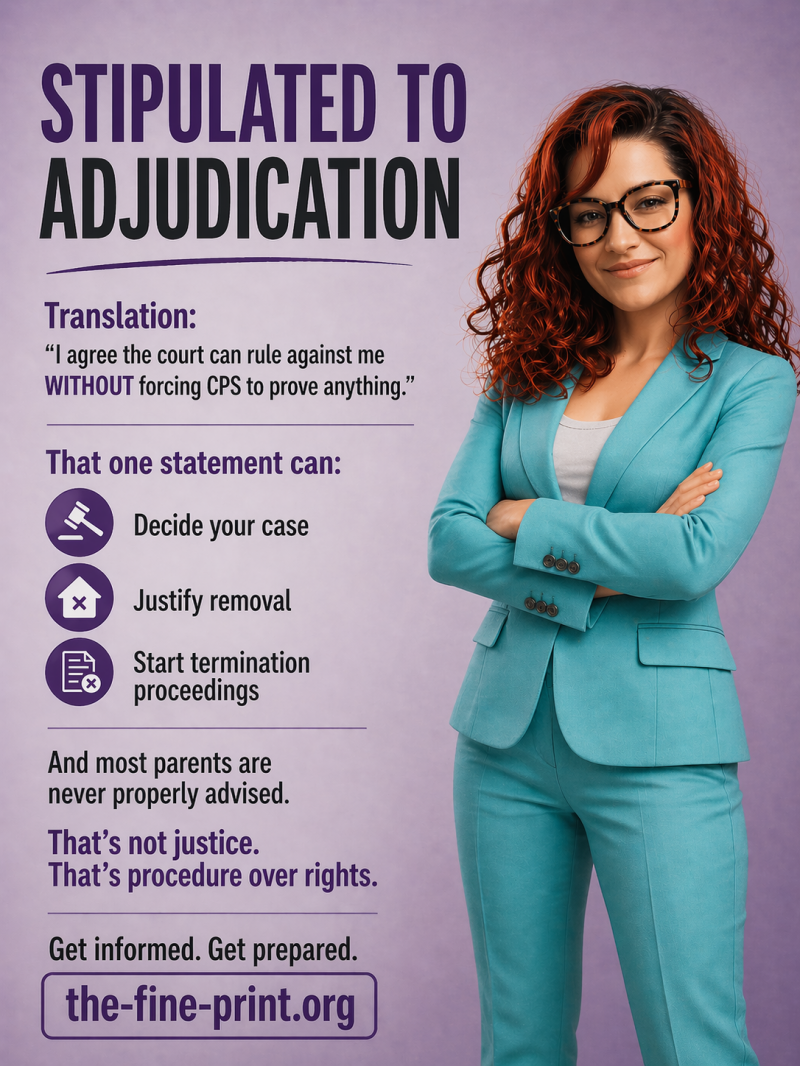
A stipulation, in its legal sense, is an agreement made during a court proceeding in which a party accepts certain facts or allegations without requiring the opposing side to prove them.
What makes this concept particularly important (and often misunderstood) is that a stipulation does not need to be written, does not require a signature, and does not depend on any formal document.
Instead, it only requires that the court determines, based on the record, that an agreement was made. So in practical terms, if the judge believes you agreed to something during the proceeding, the court can and will treat that as a binding stipulation.
This becomes especially significant in dependency and family court proceedings, where individuals are often never told they have “stipulated to adjudication.”
That phrase carries serious legal consequences.
When a parent stipulates to adjudication, they are effectively accepting the legal basis of the case (whether that be abuse, neglect, or dependency). Once that happens, the court is no longer required to hold a trial, and the State is relieved of its obligation to prove the allegations. The case immediately shifts into the next phase, where the court begins making decisions about custody, case plans, and continued supervision.
One of the most common reactions from parents in these situations.
“I never signed anything.”
While understandable, that argument does not carry legal weight in this context.
Courts routinely accept stipulations that are made orally in court, conveyed through an attorney speaking on a client’s behalf, or reflected in a transcript or audio recording of the proceeding. So if a judge asks whether you understand and agree, and you respond affirmatively (or in some cases remain silent) the court may interpret that as a valid agreement.
So from that point forward, it is treated as binding.
Courts justify this practice based on several long-standing legal principles.
First, statements made on the record are presumed to carry legal weight.
Second, attorneys are recognized as authorized representatives who can speak and act on behalf of their clients.
Third, agreements made in open court are considered binding because they occur within a formal judicial setting.
As a result, the record itself becomes the controlling authority. If the record reflects agreement, the court treats that agreement as real, regardless of whether any document was signed.
The problem, however, arises in how this process unfolds in practice. In theory, before accepting a stipulation, the court is required to ensure that the individual understands their rights, knowingly waives those rights, and is acting voluntarily.
In reality, many proceedings move quickly, explanations are minimal, and parents often feel pressure to “just agree” in order to move the case forward.
This then creates a situation where a legally binding agreement is formed without a full and informed understanding of its consequences.
Even without a signed document, the consequences of a stipulation are significant because it can result in the waiver of fundamental rights.
These include the (1) right to a trial, (2) the right to challenge the State’s evidence, (3) the right to cross-examine witnesses, and (4) the right to require the State to meet its burden of proof.
The United States Supreme Court, in Santosky v. Kramer, made clear that the State must satisfy a high evidentiary standard before interfering with parental rights.
A stipulation effectively removes that requirement by allowing the court to proceed without demanding proof.
That said, a stipulation (whether oral or written) is not immune from challenge.
It can be attacked if it was not entered into knowingly, voluntarily, and intelligently.
Courts recognize that an agreement obtained without proper understanding or under inadequate explanation may be invalid. Grounds for challenging a stipulation include the (1) failure to inform a parent of their rights, (2) a lack of understanding of the consequences, (3) ineffective assistance of counsel, or (4) the court’s failure to conduct a proper inquiry before accepting the agreement.
The framework for evaluating ineffective assistance is outlined in Strickland v. Washington, which requires showing both deficient performance and resulting prejudice.
For anyone questioning whether they actually agreed to a stipulation, while the answer may be will be found in memory or by assumption it will 100% be found in the record. The critical documents to review are the hearing transcripts, audio recordings, and court journal entries. These sources will reveal what was said by the attorney, what questions were asked by the judge, and whether any explanation of rights occurred. If the record reflects agreement but lacks any meaningful explanation or confirmation of understanding, that gap can become a central legal issue.
Understanding stipulations also requires recognizing that not all agreements carry the same level of risk. Some stipulations involve non-dispositive facts (details that do not, by themselves,) establish abuse, neglect, or dependency. These might include basic jurisdictional information, procedural acknowledgments such as service of process, or neutral background facts like school attendance or medical appointments. Stipulating to these types of facts may streamline proceedings without conceding liability.
In contrast, other stipulations directly support the State’s case and are far more dangerous.
Statements that mirror statutory definitions (such as admitting that a home was unsafe, that a child lacked proper care, or that supervision was inadequate) can satisfy the legal elements required for adjudication under Ohio law. Similarly, agreeing that CPS reports are accurate, accepting hearsay as true, or stipulating outright to abuse, neglect, or dependency effectively hands the State the proof it would otherwise be required to produce.
There is also a common middle-ground strategy that is often presented as a compromise. This may involve stipulating to a lesser category, such as dependency instead of abuse, or agreeing to certain facts without explicitly admitting legal conclusions. While this approach may appear strategic, it still carries significant consequences. It allows the court to move forward with adjudication, opens the door to removal and case planning, and may be used against the parent in later stages of the case.
A careful approach to any stipulation requires precision and clarity.
Any agreement should be explicitly limited to specific facts, clearly stated on the record, and structured in a way that does not satisfy the legal elements of the State’s case.
It should also preserve objections and avoid any unintended waiver of trial rights.
Because without these safeguards, even a seemingly minor concession can have far-reaching effects.
In many cases, particularly where the facts are disputed, there may be no safe stipulation at all when it comes to the core allegations. In those situations, the Constitution requires the State to do its job: present evidence, withstand cross-examination, and meet its burden of proof. That is the process that protects parental rights, and it cannot function properly if those rights are waived prematurely.
The reality is straightforward. A stipulation is not defined by paperwork—it is defined by the record. If the record reflects agreement, the court will treat that agreement as binding. This is why so many parents find themselves saying they never signed anything, yet remain legally bound by what occurred in court.
The final point is one that cannot be overstated. In the courtroom, words carry weight, silence can be interpreted as consent, and an attorney’s statements can bind the client. A stipulation is not a harmless procedural step; it is a strategic decision with serious legal consequences. If it moves the State closer to proving its case, it is not a convenience—it is a concession.